Plan Your Visit at Historic Halifax, NC

The North Carolina State Historic Site, Historic Halifax, is an opportunity to learn about the early history of this town and the contributions made to the early development of the United States of America.

Much happened here in this town of Halifax during the Revolutionary War period. In 1776, two provincial congresses were held here; the Halifax Resolves came out of the 4th Provincial Congress, and the NC State Constitution came out of the 5th Provincial Congress.

Historic Halifax celebrates history with historic buildings from the first 85 years of the town’s life. The oldest buildings are from the 1760s. In addition to the buildings, there are other areas of interest, including a natural spring (Magazine Springs), cemeteries, and the site of the colonial courthouse. Located in close proximity to the historic site are additional historical buildings of interest that are often open for visitors.

PLAN YOUR VISIT: There are interesting buildings to visit, from Tap Rooms to plantations to an archeological museum to a jail, as well as other areas of interest, Colonial Cemetery, a natural water spring, the footprint of the colonial courthouse, and more. Costumed interpreters are available for custom tours who will tell you the stories of Halifax.

We celebrate the contributions from Halifax to the state of North Carolina and to the development of the United States. Halifax has given North Carolina more Governors, members of Congress, attorneys general, and brigadier generals than any other county in North Carolina.
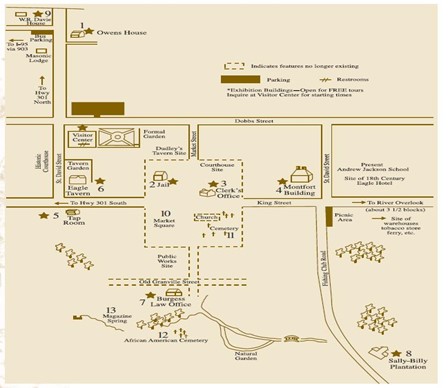
Historic Halifax NC Map


Source for State Historic Site: A History Lover’s Guide to Halifax


Summary of Places to Visit

Inventory of Historic Buildings and Areas in and adjoining the Historic District

IdLocationLocationPhoto
1The Owens House, c. 1760
36.330737005464314, -77.590344148189
2The Halifax County Jail, c. 1838
36.330162262240165, -77.58852121154705
3The Clerk’s Office, c. 1832
36.33034921921295, -77.58798418086607
4The Joseph Montfort Archaeological Museum c. 1984
36.331146468032735, -77.58734582938669
5The Tap Room, c. 1760-1790
36.32931340661792, -77.58859050137266
6The Eagle Tavern, c. 1760/90, listed on the National Register of Historic Places in 1973
36.329693016941604, -77.58902838221599
7The Burgess Law Office, c. 1806/8, listed on the National Register of Historic Places in 1970
36.32939472611274, -77.58701654078335
8The Sally-Billy Plantation, c. 1808, listed on National Register of Historic Places in 1973
36.33043272152217, -77.58515712241746
9William Richardson Davie House, c. 1783, placed on National Register of Historic Places in 1973
36.331043420084356, -77.59206257329244
10Market Square and Colonial Courthouse c. 1760
36.32900850375227, -77.58928314709283
11Colonial Cemetery
36.32935316205902, -77.58899787748743
12Hilltop Cemetery
36.33003856743813, -77.58956617697856
13Magazine Springs
36.330018128350126, -77.58963309481891
14Formals gardens at the visitors center
36.330020491094814, -77.58956326840207
15Dudley’s Tavern, mid-18th Century, extinct
36.330001732546755, -77.5895952759298
16Underground Railroad and the Roanoke River
36.32977605495125, -77.58812178316526
17Bradford-Denton House, c. 1760, owned and operated by Historical Halifax Restoration Association (HHRA)
36.33022678914699, -77.59027418551776
18Royal White Hart Masonic Lodge No. 2, chartered 1768, built c. 1824, St. David Street
36.33056688941479, -77.59087523934524
19Halifax County Courthouse
36.32899839039645, -77.5893233336252
201
1