
For hundreds of years, early Native Americans inhabited the lands in northeastern North Carolina along the Roanoke River. This major river flows from Virginia into North Carolina, reaching the Albemarle Sound and eventually the Atlantic Ocean. In the early 1700s, colonists traveled up the Roanoke River and discovered the valley’s fertile bottomlands, which proved ideal for large-scale planting. Navigation further inland up the river was hindered by falls and rapids.
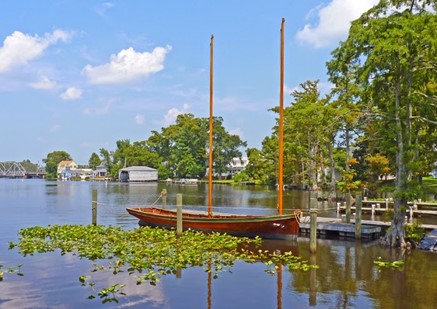
The location of this settlement that grew into the town of Halifax was bounded on one side by the Roanoke River at the head of navigation and became a nucleus for trade for the entire valley. The settlement quickly grew into a social center where people gathered to move goods between the backcountry and the plantations of Virginia. Warehouses were built along the riverbank to accommodate the trade goods. The natural topography of the riverside included a deep ravine or gully. A ferry was built to transport people from the Halifax County side of the river to the Northampton County side. One colonial traveler noted that the Halifax Ferry House, although built on dry land, was lashed to trees to keep it from being washed away by high water. Heavy rains and flooding were a periodic problem for the growing crops along the river. Finally, a major flood in the 1940s resulted in the construction of dams on the river to control the floodwaters.
In the 1750s, a town area for Halifax was defined with the purchase of one hundred acres of land from James Leslie on the south bank of the Roanoke River. Streets and lots were laid out in a grid plan, oriented perpendicular to the river. Four acres in the center were reserved for government buildings. A cross grid of streets created square of land, each containing six large lots. In June 1758, a public sale of the lots was conducted by five appointed town trustees and forty-nine buyers purchased nearly all. The buyer of each lot was required to build a house of a certain size within three years.
In 1757, the town was officially named Halifax for George Montague, second Earl of Halifax and president of the British Board of Trade and Plantations. Royal Governor Arthur Dobbs (1689-1765) suggested this. In 1759, Halifax County was formed, carved from Edgecombe County. By 1760, the town had nearly sixty houses and public buildings and was incorporated as a borough town, which allowed it to send a representative to the House of Commons. Since Halifax offered a more central location to the surrounding counties of Edgecombe, Granville, and Northampton, it was chosen as the county seat over the older town of Enfield. A wood-frame county courthouse was erected on Market Square. On November 21, 1767, the town of Halifax was officially certified by the colonial legislature in New Bern.
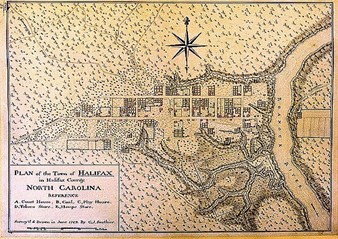
An important historical map, completed in 1769 by surveyor Claude Joseph Sauthier (1736–1802), details the locations of the courthouse, jail, tobacco store, hemp store, playhouse (theatre), and over sixty houses. The original map is now housed in the State Archives in Raleigh, NC.
By the 1770s, Halifax became the scene of important political events. People from far and near gathered on court days, election days, and market days. A farmer’s market operated near the river dock. Halifax was home to several taverns, or “ordinaries,” which provided meals and lodging and provided a location for folks to share news. These establishments also hosted traveling performers, exhibitions, and gaming, including billiards, card games, dice, backgammon, and chess. Horse racing became an important sport.
Halifax’s taverns, such as “The Sign of the Thistle,” “Dudley’s Tavern,” and “Johnson’s Tavern,” served alcohol, especially rum punch and Madeira wine. Locally brewed beers were also popular, with beer-brewing being an important part of tavern-keeping in early Halifax.
Today, there are two 18th-century taverns open to the public: the Eagle Tavern, once operated as “The Sign of the Thistle,” and the Tap Room, which was originally part of a larger complex that operated under many names, including “Johnson’s Tavern,” “The Mansion House,” and “Pope’s Hotel.”
In the 1760s, resistance by the people against taxes imposed by England grew particularly with the lack of colonial representation in decision-making by the ruling England. Talk of independence increased. In February 1776, blood was split on North Carolina soil at the Battle of Moore’s Creek Bridge near Wilmington, NC, The NC militia battled Loyalists and were successful. A number of captured loyalist were bought to Halifax to be jailed. Many were Scottish Highlanders including the General Donald McDonald who had been sick during the battle and unable to fight. His brother Allan McDonald was also one of the prisoners. The wife of Allan McDonald was Flora McDonald, renowned for helping Bonnie Prince Charlie escape after the 1745 Battle of Culloden in Scotland. AFter months, these prisoners were taken to Philadelphia and eventually exchanged. Their choose of supporting England in this conflict resulted in their losing their property. Several moved to Nova Scotia and/or returned to Scotland.
The times during the Revolutionary War era were complicated and residents of Halifax had to choose side. In many cases, citizens and family members ended up on opposite sides of the conflict. The stakes were high; the losing side risked their lives, liberty, and property.
In the spring of 1776, the town of Halifax hosted the 4th Provincial Congress. The minutes of this congress document the important unanimous approval of the Halifax Resolves on April 12. The eighty-three delegates, representing the counties and towns of North Carolina, through this resolution directed the three NC representatives at the Continental Congress in Philadelphia to move toward independence. North Carolina was the first colony to do so, earning it the motto “First in Freedom,” a date commemorated today on the state flag.
Later that same year, Halifax hosted the 5th Provincial Congress, which crafted the state’s first constitution, a difficult task to establish a structure for governing the colony. Richard Caswell, leader of the congress, was appointed the first governor.
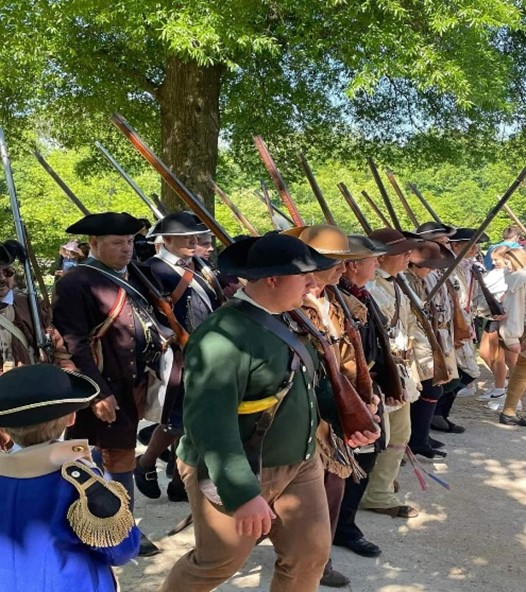
Halifax became a logistical center for military activity with a supply depot for the NC Continental Army and headquarters for militia regiments from Edgecombe, Franklin, Halifax, Martin, Nash, Northampton, and Warren Counties. It developed public arms factories. During the Revolutionary War, Halifax also served as a recruiting center with Citizen soldiers gathering on muster days to drill on Market Square. Though records are scarce, some African Americans and Native Americans participated on various sides of the conflict.
In May 1781, the war came to Halifax. British troops on their way to Virginia led by the ruthless Colonel Banastre Tarleton preceded Lord Cornwallis and committed such atrocities that Cornwallis had two men court-martialed and hanged. The British soldiers encamped at the Willie Jones plantation near Quanky Creek on the outskirts of the town waiting for the river to become crossable. About two weeks later, they were able to cross the Roanoke River, continuing their march to Virginia where five months later, Cornwallis surrendered to George Washington at Yorktown.
After the Revolution, Halifax residents continued their involvement in the development of the fledging United States. One notable Halifax resident was William R. Davie. Raised in the Waxhaws region along the NC–SC border, Davie developed a leadership role in several battles around Charlotte and in South Carolina. He moved to Halifax in 1785, marrying a daughter of General Allen Jones and establishing a law practice. Serving as a delegate to the Constitutional Convention in Philadelphia, he proposed several additions to the constitution. One was the controversial three-fifths compromise which was a problematic solution to ensuring NC had sufficient population representation to compete with northern states. Secondly, he suggested inclusion of the impeachment procedure to hold officials accountable for misconduct. Ratification of the US Constitution of the state of NC was a difficult path and Davie worked with the anti-Federalist to resolve conflicts. One of the most famous anti-Federalist leaders was Halifax resident, Willie Jones, the uncle of Davie's wife. Their resistance contributed to the adoption of the Bill of Rights. In 1789, NC became the twelfth state to join the Union.
By the 1770s, Halifax, with nearly sixty buildings, had grown into one of the most populous towns in NC. Farming and trade supported a wealthy elite active in politics, business, and leisure activities such as horse racing. By the 1790 census, Halifax County was the second most populous in the state, with 14,310 residents, including 6,697 enslaved people. Free African Americans made up 3 percent of the population, rising from 443 in 1790 to 635 in 1800. Many worked as artisans, craftsmen, and traders, and some owned property in Halifax and the surrounding area.
The labor force included enslaved and free African Americans, Native Americans, and indentured servants. Native Americans in Halifax County were often recorded under the “nonwhite” category, and many had moved north to join other tribes. Some served as craftsmen, laborers, or domestic workers. The Roanoke River frequently flooded, damaging crops. Drinking water was drawn from natural springs, like Magazine Springs, located behind the Tap Room on King Street. This spring, used since Native times, remains significant to the Haliwa-Saponi Tribe today.
Educational opportunities were limited. Wealthier families sometimes hired tutors, often in cooperation with other families. Churches also provided instruction. Schools, usually boarding, were mostly for boys. Women’s education focused on household skills, as women could not hold office, vote, or own property. In 1789, Halifax resident William Richardson Davie introduced the bill that established the University of North Carolina at Chapel Hill, the first state university. He selected the site, developed the curriculum, hired instructors, and chaired the Board of Trustees, earning recognition as “Father of the University.”
The first church in Halifax, a nondenominational meetinghouse, was built near the colonial cemetery. Its footprint is marked on the historic site. Anglicanism, originally dominant among the early settlers, declined after the Revolutionary War period, while Methodist and Baptist congregations grew.
Freemasonry also played an important role in Halifax. It is significant that George Washington was a mason and many of the political leaders of this early time were members. The Royal White Hart Lodge of Halifax was chartered in 1767, the second oldest lodge in North Carolina. Joseph Montfort (1724–1776) became Provincial Grand Master of and for America in 1771. William R. Davie was a Mason and later served as Grand Master of NC (1792–1798). In 1793, he laid the cornerstone for the first building at UNC Chapel Hill in a full Masonic ceremony.
In 1791, Halifax Freemasons welcomed George Washington during his southern tour. Washington stayed with William Richardson Davie, though anti-Federalist Willie Jones reportedly refused to greet him as president, only as a man and soldier.
The Marquis de Lafayette was invited back to the United States by President James Monroe fifty years after independence was declared. Lafayette, a young French noble, was celebrated nationwide for his Revolutionary service and loyalty to George Washington, often contributing his own funds to support the Continental Troops. He came to Halifax on February 26, 1825 and was welcomed by Allen Davie, the son of William Richardson Davie. Lafayette stayed overnight at the Eagle Tavern and traveled the next day to the town of Enfield where he was hosted by Joseph Branch at his home, "The Cellars".
In 1792, Raleigh was selected as the capital of the state of North Carolina. The small town of Halifax thrived until the 1830s, when the new railroad bypassed the town in favor of nearby Weldon. The Civil War Conflict later resulted in the collapse of the plantation system setting Halifax back as a quiet, rural community.
Today, Halifax continues as the county seat of Halifax County. The contributions of the past are celebrated by The Historic Halifax State Historic Site which provides tours, events, living history programming, offering visitors a glimpse into the town’s past and an opportunity to reflect on the history of our country.