This elegant, transitional Georgian-Federal residence of William Richardson Davie was built several blocks from the market square in Halifax but is located within the state historic district. This two-story, side-hall wood frame house is three bays wide and double-pile. The house features a decorative center front gable with boxed eaves with large and small dentil molding, nine-over-nine sash windows, and two double-shouldered, gable-end chimneys. The double-leaf front entrance on the left end of the façade has a multi-light transom and is sheltered by one-bay, pedimented entrance porch with paired boxed posts and dentil molding matching that of the main roofline. On the south side is a recessed, two-story, side-gabled wing of height lower than the main block. It features a front porch with boxed posts and arched soffits, and an exterior, double-shouldered, gable-end chimney.
William Richardson Davie, 1756-1820, was born in England to Scottish parents, but brought to America as a child around 1764 where they settled in the Waxhaws area along the Catawba River on the borders of NC and SC where his uncle was minister in the local Presbyterian Church. He eventually attended the College of New Jersey (now Princeton University) and was certified to practice law after reading law with Judge Spruce Macay in Salisbury. Several times, he interrupted his education to join with other patriots in the fight for independence from England. After resolution of the conflict, he married the daughter of General Allen Jones and moved to Halifax.
During the twenty-year period that Davie lived in Halifax1785-1805, he became one of the most important political leaders in North Carolina. Not only was his military service notable, he also served many years in public service, being a delegate to the 1787 Federal Convention in Philadelphia, a NC governor, a peace emissary to France, and is most remembered as the founder of the first state university, now the University of North Carolina at Chapel Hill. As the grand master of the masonic lodge, he laid the cornerstone of the first building on campus in 1793. As well as serving on the Board of Trustees, he selected curriculum and the teachers.
After returning to Halifax in 1800from France, he found that the political winds had changed. In 1802, his wife Sarah died and was buried in Halifax. In 1805, he lost a major election which caused him to decide to move to his plantation in the Waxhaws in South Carolina. His son Allen Jones Davie, continued to live in the Halifax home for several years. Changing ownership several times, the house was altered, most significantly in the 1930s with an additional on the left side by Joseph Hunter Norman, a register of deeds for Halifax County.
Source: William R. Davie by Blackwell Pierce Robinson.
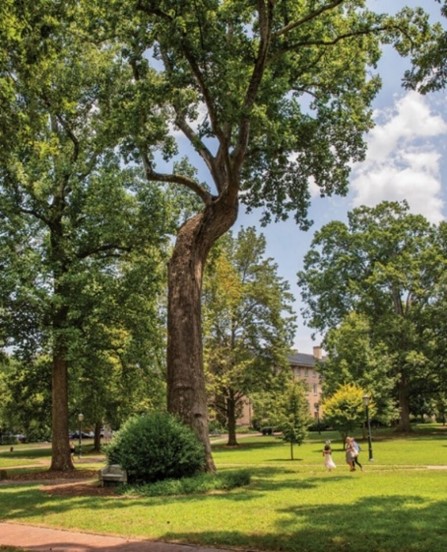
The legend states that WR Davie in his search to find a location for the first state university, sat under a poplar tree on land in Orange County when he decided to seat the university there.
This tree, carefully nurtured over time, is on the campus of UNC CH.
Photo credit: The Legacy of Chapel Hill’s Davie Poplar | Our State
