The fireproof, brick, Clerk’s Office was constructed c.1832 at a cost of $1600, acknowledging growing concern for proper storage of court documents and legal records after an 1831fire destroyed records in the Capital Building in Raleigh. The late-Federal building with Flemish-bond brick construction has plastered cove cornices and is a one-story gabled building has stepped gable parapets with flush end chimneys and a modern metal roofing. The doors are metal-sheathed, beaded board and batten. There are three rooms in the interior with no doors that originally housed a Register of Deeds Office, a Superior Court Clerk’s Office and the County Clerk’s Office. The walls are plaster.
In 1846, a new county courthouse was built on King Street which resulted in the clerk’s building being purchased by a local attorney, John R. J. Daniel. From 1941-1963, it served as the Halifax County Public Library and in 1970, it was acquired by Historic Halifax Restoration Association (HHRA), restored, and donated as part of the Historic Halifax State Historic Site. Today, one of its rooms is furnished as a court official’s office and another as a printer’s office, complete with a working press.
Communication in early colonial times were of the upmost importance. In 1785, Abraham Hodge moved to Halifax to establish a printing office and was also appointed the state printer. Hodge worked in partnership with several different printers, establishing printing offices in Edenton, Fayetteville and New Bern in addition to Halifax, He was served as a public printer for fifteen years, started three newspapers, and printed almanacs. The 4th Provincial Congress that met in Halifax in spring of 1776 approved paper money issue that consisted of 54 different designs and seventeen denominations from 1/16 dollar to twenty dollars. Most notes depict an animal.
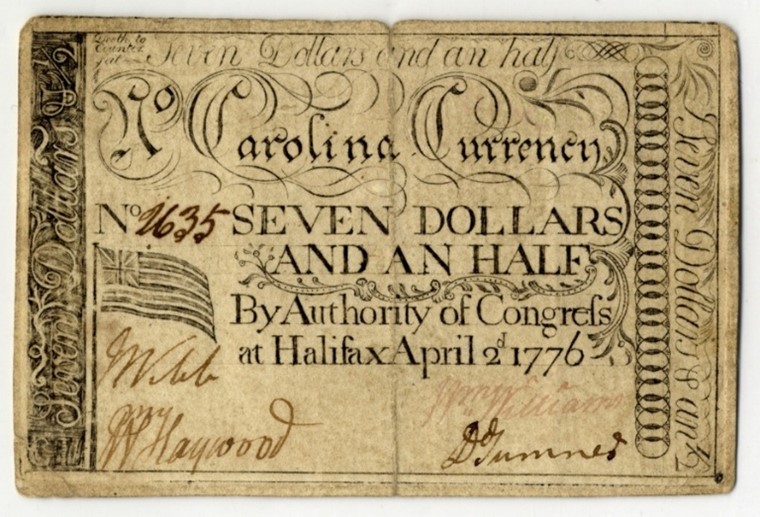
The seven and ½ dollar note depicts the Grand Union flag, considered to be the first national flag of the United States. This design of the flag with the British flag in the left upper corner is important because it indicates that American first thought of themselves as an independent part of England.
Source: www.museum.unc.edu/exhibits/show/artmoney/earlypaper
